Breaking the Cycle: Why the POSS-I Study Points Toward a New Scientific Paradigm
Based on methodological reflections of Dr. Beatriz Villarroel, astrophysicist and lead researcher of the VASCO project, synthesized with findings of Bruehl & Villarroel (2025) in Scientific Reports

The flaw hidden in the name
The dominant methodology for studying what we call “UAP” has a structural flaw baked into its definition. A UAP — an Unidentified Aerial Phenomenon — is, by construction, whatever remains after all known explanations have been exhausted.
When the method mirrors the definition this precisely, the outcome is guaranteed: we produce an ever-growing catalog of things we cannot explain, and we get better and better at measuring the limits of human identification in the sky. That is a psychology study. It is not a physics one.
Dr. Beatriz Villarroel, whose methodological essay prompted this analysis, puts it plainly: “By choosing the name UAP/UFO, our methodology to study the phenomenon mirrors the definition and makes the said ‘UAP’ severely difficult to understand in detail.” The stigma that accumulates around that failure then makes each subsequent round of serious inquiry harder to fund, harder to publish, and harder to pursue without professional risk. The cycle feeds itself — and has done so for seventy years.
What breaks the cycle is not a better name for the residual category. It is abandoning the residual category entirely, in favor of specific, falsifiable hypotheses about specific, physically defined objects.
What the POSS-I paper actually demonstrates
The recently published study by Bruehl & Villarroel in Scientific Reports is being discussed primarily for what it found. It deserves equal attention for how it found it.
The researchers began with a precisely defined object: a star-like point source, lasting less than 50 minutes, absent in images taken immediately before and in all subsequent surveys, with no known counterpart in Gaia DR3 or PanSTARRS DR1. Over 107,000 such transients were identified in the Palomar Observatory Sky Survey (POSS-I) from 1949 to 1957 — before the launch of the first artificial satellite. From that specific, instrumentally grounded starting point, they could ask meaningful secondary questions.
The results were significant. Transients were 45% more likely to occur on dates within one day of an above-ground nuclear weapons test (p = .008). On dates when at least one transient was observed, there was a small but statistically significant correlation between the number of transients and the number of independent UAP witness reports (p = .015) — with every additional UAP report associated with an 8.5% increase in transients observed that date. When nuclear testing and UAP reports were combined as predictors, their effects on transient counts were additive.
Crucially, the findings actively disconfirm the most obvious prosaic explanations — not rhetorically, but through the structure of the data itself. Nuclear fallout contaminating photographic plates produces diffuse fogged spots, not the discrete star-profiles with point spread functions characteristic of the transients.
Observer bias cannot account for a consistent one-day lag between testing and peak transient occurrence — the test dates were generally classified, and the individuals filing UAP reports had no knowledge of them. The data pattern is not consistent with local contamination, emulsion defects, or any artifact of the observatory itself, because those mechanisms have no mechanism to correlate with global nuclear events or witness reports from multiple countries.
This is the scientific method functioning as designed: specific hypothesis, observable proxy, quantitative test, falsifiable result. It is what seventy years of UAP research has largely failed to produce — and it happened precisely because the researchers defined what they were looking for before they looked.
The “flying saucer” problem
Dr. Villarroel’s observation about terminology is more than semantic. “Flying saucer” — the term that was stigmatized into obsolescence — is, in scientific terms, the more useful descriptor. It implies a specific geometry, a specific reflective profile, a specific radar cross-section, a specific behavioral envelope. You can build a search algorithm for flying saucers. You cannot build one for “unidentified aerial phenomena” because the definition excludes nothing and commits to nothing.
The same principle applies at finer resolution. “Glowing orb” carries physical specificity — spectral emission profile, angular size, luminosity range. “Small gray beings” is a morphological claim that can be cross-referenced across thousands of independent accounts globally.
These terms feel uncomfortable to academic institutions precisely because they carry content. But content is what makes a hypothesis testable. The POSS-I transients were findable because they had a specific definition. The same logic must be applied to the broader phenomenon.
Whether the collapse from “flying saucer” to “UFO” to “UAP” was a deliberate act of institutional management or an emergent product of professional self-protection is ultimately less important than recognizing its functional effect: it made the phenomenon maximally difficult to study with precision. Reversing that — stating clearly that we are looking for non-human spacecraft, or extraterrestrial artifacts, or structured craft with specific observable properties — is scientific hygiene.
Three testable problems, grounded in what we now know
Dr. Villarroel proposes breaking the research agenda into problems where the terminology is either clear or secondary. The POSS-I study provides direct empirical support for the feasibility of each.
Can we find signatures of non-human artifacts outside or inside the atmosphere? The VASCO/POSS-I approach answers this affirmatively: objective sky survey data, searched for signatures with defined physical characteristics, yields statistically significant and reproducible results.
The immediate next step is AI-assisted validation of the full 107,000+ transient catalog — producing a taxonomically clean dataset of specific object subtypes, cross-referenced with spectral data, duration profiles, and multiplicity. Modern sensor arrays, designed around specific target signatures rather than anomaly detection in the abstract, can then extend this work prospectively. The signal is in the data. It has always been there.
Does the presence of these objects correlate with measurable risk? The negative binomial GLM framework used in the POSS-I study — showing additive correlations between transients, nuclear testing, and UAP reports — is directly applicable to aviation incident databases, maritime disappearance records, and military airspace anomaly logs.
The question of whether the phenomenon poses a threat can be answered statistically without first resolving what the phenomenon is. That separation of questions is both methodologically sound and institutionally important: it is the argument most likely to sustain research funding regardless of one’s prior views on the phenomenon’s origin.
Are there physical objects with anomalous properties left at landing or encounter sites? The POSS-I finding that transients peak one day after nuclear tests — not the day of — points toward a delayed physical mechanism of some kind. Whatever that mechanism is, it is not instantaneous atmospheric ionization. This is the beginning of a testable physical model. The same logic applies to trace evidence from reported landing sites: if specific material anomalies are consistently associated with specific object morphologies, that is a materials science problem with a defined hypothesis. The object has to have a descriptive name to be the subject of a coherent investigation.
What the science owes the experiencers
Dr. Villarroel’s framework is a scientific argument. But it has a human dimension that cannot be separated from it.
Among the responses to her essay, one reader — Jeffrey W. — wrote: “I had some very strange experiences when I was a child that I now associate with non-human intelligence. The most frustrating thing for me has always been that nobody has ever taken me seriously. I make no claims about these experiences, except for their apparent intelligence.”
Jeffrey’s epistemic precision is worth noting. He makes no ontological claim about what the phenomenon is. He reports a quality — apparent intelligence — which is, in the language of Dr. Villarroel’s framework, a specific observable property. That is exactly where scientific inquiry should begin. The stigma cycle that prevents a credentialed astrophysicist from publishing on this topic without professional risk is the same cycle that has kept Jeffrey’s account uninvestigable for decades. The mechanisms are continuous.
Antonio J. Alves — Portuguese experiencer and author of Gods or Civilizations from the Stars — adds another dimension. His account, spanning a lifetime and encompassing structured craft, non-human beings of multiple described morphologies, missing time experiences, and what he interprets as intelligently directed communication, began with a single childhood event: an intense white light in the sky over Portugal.
What makes his testimony particularly significant from a methodological standpoint is the pattern structure: multiple members of his family — mother, father, aunt, uncle, and daughter — report independent experiences consistent with his own across generations. That is a data cluster. Familial and generational clustering of contact experiences, if it holds across independent sampling, is a testable hypothesis with genetic, psychological, and potentially epidemiological dimensions.
His broader argument — that ancient religions, global myths, and sacred texts may encode contact experiences with non-human intelligences — is routinely dismissed in academic circles on the grounds that ancient witnesses were pre-scientific and unreliable. But this objection, applied consistently, would also invalidate the UFOCAT witness report database that Bruehl and Villarroel used to obtain their p = .015 result. The epistemological standard has to be consistent.
Ancient texts offer the possibility of independent replication across time: if the same morphological descriptions, behavioral patterns, and apparent purposes appear across Vedic texts, Sumerian records, Mesoamerican cosmologies, and contemporary experiencer accounts from Portugal and Brazil, that cross-cultural convergence is a data point that deserves analysis rather than reflexive dismissal.
The deeper Fatima connection Alves raises — including the mass-witness event of October 13, 1917, involving an estimated 70,000 observers and contemporaneously documented descriptions of anomalous aerial phenomena — has been studied almost exclusively through a religious lens. It has rarely been treated as what it may also be: a historical UAP event with thousands of independent witnesses and enough archival documentation to apply exactly the kind of correlation analysis Bruehl and Villarroel demonstrated with the POSS-I data. That work has not been done. It could be.
The code embedded in the event
Among the elements Antonio Alves raises, one stands apart for its rarity in the experiencer literature: a specific numerical sequence — 135917 — communicated within his encounters and linked, he argues, to the events at Fatima.
This AI-assisted interpretation is an example of how it might apply:
“Read as a compressed date cipher, it maps precisely onto the Fatima apparition sequence: the 13th of each month, beginning in May (5), running through September (9), culminating in the mass-witnessed event of 1917. Six apparitions. Six recurrences of the same date. The number encodes the entire calendar architecture of the event in seven digits.”
Note: Antonio has indicated there might be another meaning as the interpretation does not resolve the missing (1)917.
What does make this element significant is the pattern — the same quality of structured, internally coherent information that serious researchers of non-human communication have flagged as a potential marker of intelligence.
A random experience does not generate verifiable calendrical encoding. A communicating intelligence, if that is what we are dealing with, might. This is precisely the kind of specific, cross-referenceable claim that Dr. Villarroel's framework is designed to handle: not "something strange happened at Fatima," but "a specific numerical structure was transmitted, and it (possibly) encodes a specific historical event, and that claim can be examined."
Whether 135917 ultimately points toward human pattern-recognition reaching for meaning, or toward something genuinely structured in the phenomenon itself, is a question worth asking rigorously — and it is a question with a shape precise enough to investigate.
The only thing required
Rigorous, hypothesis-driven science of the kind Dr. Villarroel advocates is the mechanism by which experiencers can finally be taken seriously. The stigma cycle consigns both the scientist and the witness to the same institutional silence. Breaking it requires the same move in both contexts: naming, specifically and without embarrassment, what we believe we are looking at — and designing our methods accordingly.
The POSS-I paper is proof that when you ask a precise question about a precisely defined phenomenon, you get a precise answer. The transients in the July 1952 survey images — appearing over the same weekends that structured craft were tracked on radar over Washington D.C. — have been in the archive since they were photographed.
They did not become significant when the paper was published. They became significant when someone asked a specific enough question to find them.
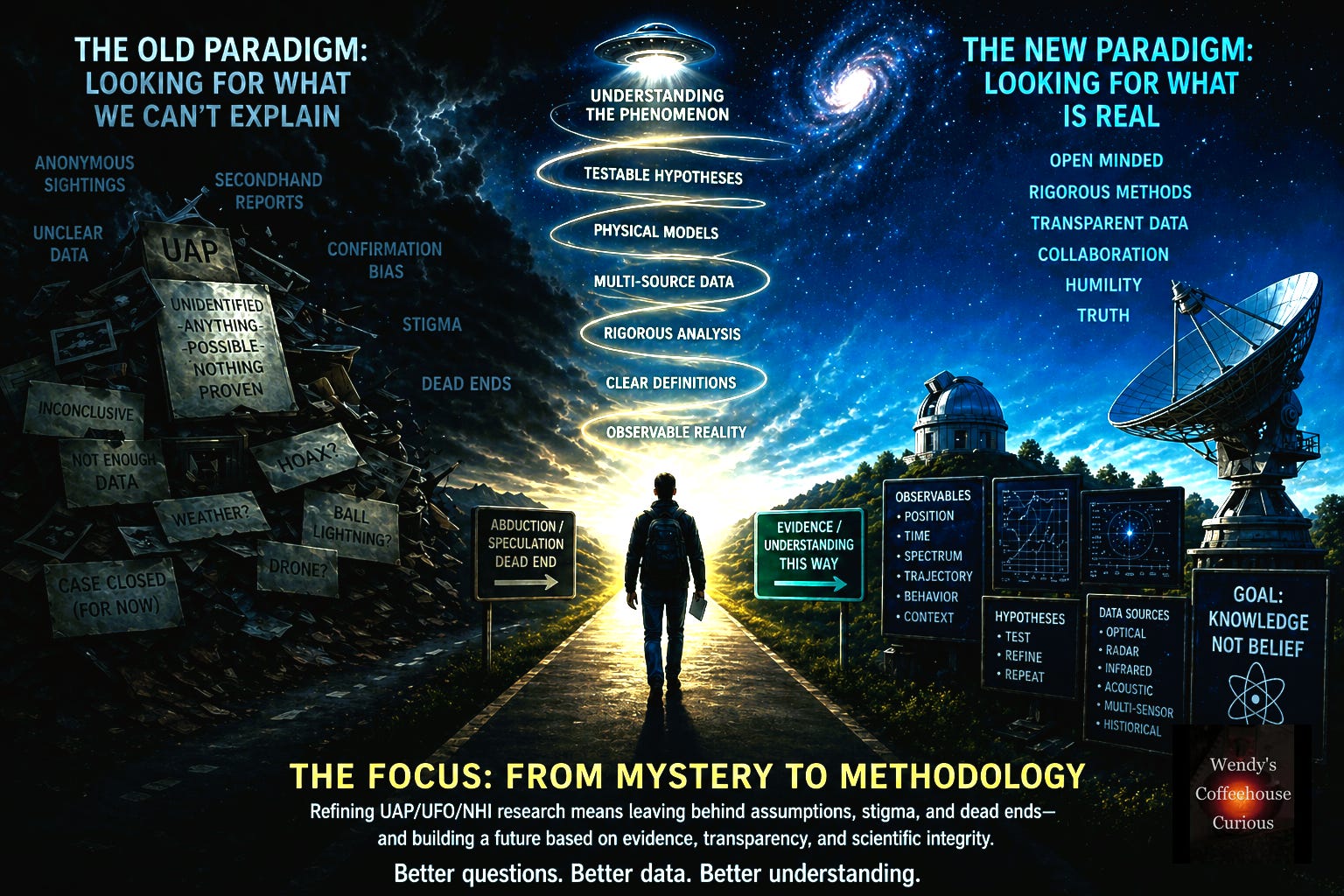
The next seventy years do not have to look like the last.
The POSS-I study referenced throughout is: Bruehl, S. & Villarroel, B. “Transients in the Palomar Observatory Sky Survey (POSS-I) may be associated with nuclear testing and reports of unidentified anomalous phenomena.” Scientific Reports 15, 34125 (2025).
Antonio J. Alves is the author of Gods or Civilizations from the Stars, available on Amazon and freely through his Instagram: @dce.alves. His interview appears on Wendy’s Coffeehouse Curious podcast. Link.